How to start a hotel business in Dubai: 12 steps for a successful start in 2026
How to start a hotel business in Dubai: 12 steps for a successful start in 2026
A definitive guide to everything an entrepreneur needs to know about starting a hotel business in the thriving emirate of Dubai.
Vincy Amirtharaj
58 post
Senior Business Setup Consultant, Dubai
Dubai creates an agile foundation for every business and across all industries by providing direct access to growth markets and an up-to-date infrastructure. Setting up a hotel business in Dubai is a prime investment opportunity today, most particularly with the city’s plans for developing the tourism sector. As per the Dubai Department of Economy and Tourism (DET) recent data Dubai has welcomed 9.88 million international overnight visitors between January and June 2025. A 6% increase compared to the same period in 2024 proves the effectiveness of Dubai’s evolving destination offerings.
If you are planning to start a hotel in Dubai, the process begins with choosing a business structure and location followed by managing the paperwork and approval requirements to ensure a smooth and compliant launch. Throughout this guide you will find all the essential steps to successfully set up your hotel business in Dubai.
“Dubai’s ability to create compelling experiences that meet the evolving needs of visitors has strengthened its status as one of the world’s most sought-after destinations. From exceptional infrastructure to unique attractions, Dubai offers a model of excellence in the tourism and hospitality sectors grounded in innovation.”
- His Highness Sheikh Hamdan bin Mohammed bin Rashid Al Maktoum, Crown Prince of Dubai, Deputy Prime Minister, Minister of Defence, and Chairman of The Executive Council of Dubai
Step 1: Choose a hotel business idea
Do your research carefully to understand the demand for hotel services in Dubai and then decide on the specific hospitality niche. There are certain aspects related to hotel business practices that need a prior knowledge before settling in on one idea:
Type of property
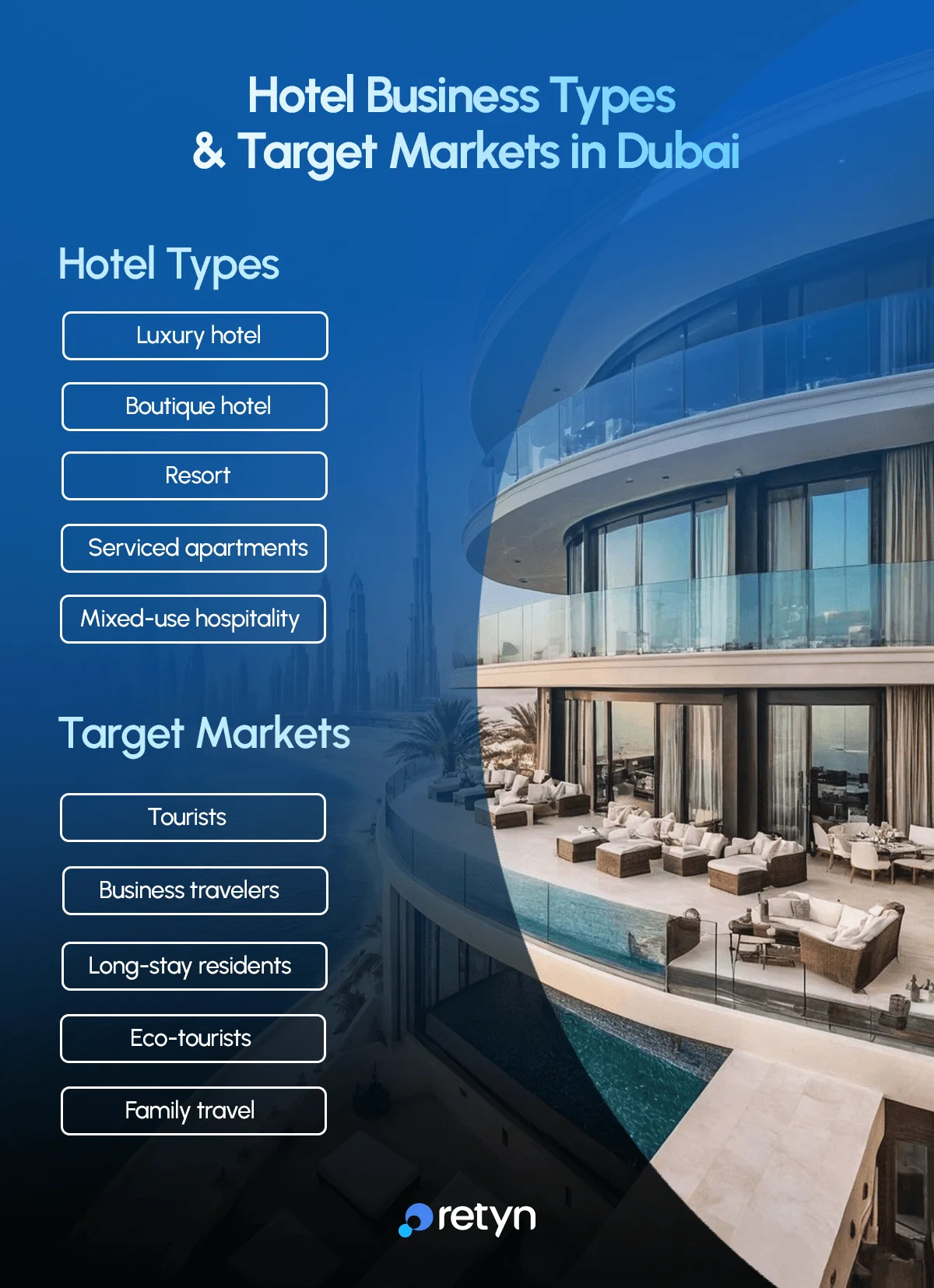
Based on the level of luxury and services, categories that individuals can select include luxury hotels, resorts, boutique hotels, serviced apartments or mixed-use hospitality.
Target market
Your guest segments may include tourists, business travellers, residents who prefer to stay longer or eco-tourism and family-focused travellers.
Location strategy
Gather an idea about the tourist hotspots in Dubai, for it will help you in choosing a location that is quite near to important hubs.
Revenue model
Consider the financial soundness of your hotel project. Weigh in the factors like room rates, spa requirements, food and beverage, ancillary services, to name a few.
Quick fact
DET’s study from January to June 2025 highlights that the average occupancy for hotels in Dubai stood at 80.6%. A 78.7% increase when compared to the same period in 2024 affirms the steady growth of the emirate’s hotel sector across all hospitality metrics.
Step 2: Choose a trade name
A complete understanding of UAE naming rules will help you in settling the right trade name and lower the chances of cancellation by DET.
Check the DET portal to confirm if the name is already reserved for the same activity or any similar activity. Completely avoid the terms that are attributed to global political or religious sectarian organizations. If your hotel business is registered under any particular legal entity type, mention the legal identifiers as well, such as Mainland LLC or FZ-LLC.
Step 3: Create a hotel business plan
A hotel business plan doesn’t just support your entry into the UAE’s hospitality market but also assists with DET approvals, banking processes and attract investors.
An executive summary including the company’s objectives, chosen activities, target audience, legal structure, unique offerings and market potential.
A strong marketing and sales strategy outlining how you will use online travel agencies, corporate bookings and encourages repeat business.
Outline recruitment and operational plans such as the number of employees, visa plans, hotel management team, training and required infrastructure and tools.
Financial highlights with setup costs, funding requirements, projections, occupancy rates and cash inflows and outflows.
Plan for ensuring compliance by including DET licensing, taxation (VAT and corporate tax), municipal fees, Tourism Dirham fee and labor laws.
Pro tip
Having a thoroughly prepared bankable dossier can make licensing and banking formalities more efficient.
Step 4: Select a legal structure
The Emirate offers a variety of ownership structures to accommodate the diverse needs of hotel businesses. Most common types for business setup in Dubai may include:
LLC (Mainland)
The standard type of hotel or resort setup in the UAE mainland. The advantages offered are flexibility for direct onshore operations and the ability to bid for government contracts. On the basis of the current Commercial Companies Law, 100% foreign ownership is available for most Mainland LLCs with no need for a local sponsor or service agent. The DET is responsible for issuing the necessary license to regulate the activity.
Free Zone FZ-LLC/FZE
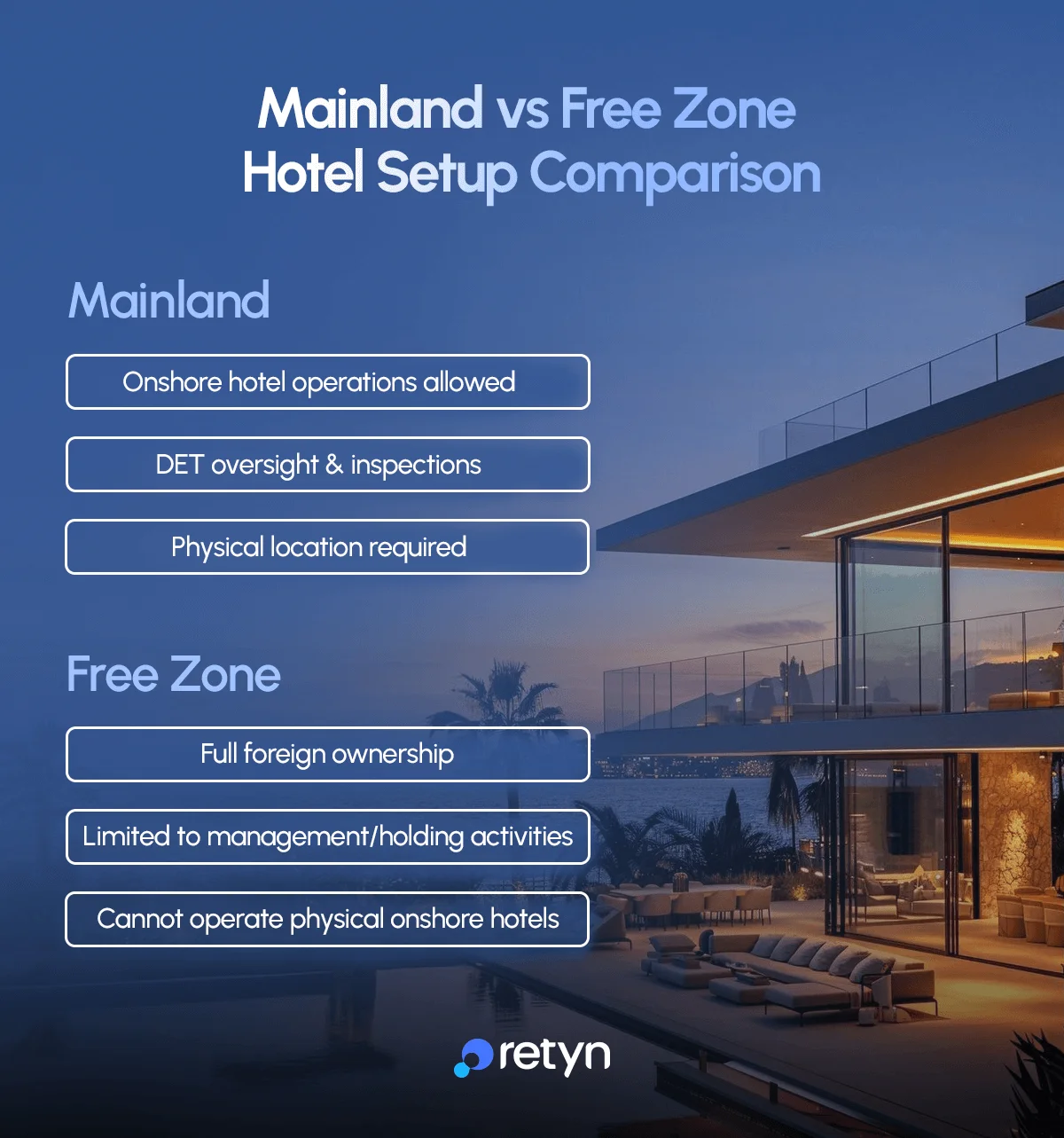
Either set up a Free Zone Limited Liability Company (FZ LLC) or Free Zone Establishment (FZE). The difference is mainly based on the number of shareholders and whether the shareholder is a natural person or a legal person. This establishment is suitable for management, investment holding or booking platforms. Running a physical hotel that serves onshore guests is not allowed within this structure.
Pro tip
Mainland hotel licenses involve more regulatory inspections (DET, DCD, Municipality), while free zone structures offer lighter compliance but cannot operate onshore hotels.
Want an idea of the setup cost before you begin?
Check the cost calculator on our business setup page for an instant breakdown. It helps you understand your options early and make informed decisions.
Dubai has its own unique regulations, tax benefits and incentives. Whether you would like to go for a free zone or establish a mainland company, first evaluate your requirements and then make a decision.
Mainland
A business jurisdiction monitored by DET. Mainland company formation in Dubai is mandatory for all hotels, resorts and serviced apartments aiming to serve onshore guests. The zone provides greater flexibility in terms of business activities, government contracts, DET trade licenses and hotel classification. Registering a tenancy agreement through the Ejari system in Dubai is required if your hotel is operating from leased or rented premises.
Free zones
Intended for companies engaged in hotel management, asset holding or investment rather than direct operations. Unlike mainland, free zone company formation in Dubai cannot run physical hotels for onshore clientele.
Decision shortcut:
Physical hotel/resort → Mainland.
Management company, investment holding or booking platform → Free Zone.
Step 6: Register your hotel business (license issuance)
Reserve the trade name and register under the appropriate business activity category to acquire a hotel license in Dubai from the Dubai Department of Economy and Tourism. Following this, prepare and submit documents such as a Memorandum of Association and board or shareholder resolutions.
All hotels need to register with the Dubai Municipality (DM) and obtain necessary approvals from relevant authorities for waste management, sanitation, public health, etc. Ejari registration is required only for leased properties. Additional permissions from Civil Defense, municipality and environmental-related authorities are essential to ensure operational safety.
Step 7: Mandatory hotel classification
A license for hotel services (be it hotels, resorts or serviced apartments) in Dubai requires you to obtain a classification from the DET. Based on facilities and services, the grading ranges from 1-star to 5-star or deluxe or specialty. This specifies the standards and amenities essential for proper operation.
You will get a classification certificate after submitting property documentation, amenities, floor plans and pay applicable fees once the site inspection is approved. Obtaining a classification card is mandatory to legally operate your hotel business in Dubai.
“Our response has been both deliberate and future-focused: enhancing visitor experiences through technology, investing in high-growth segments such as luxury, wellness, and experiential travel, and promoting deeper cultural exchange through local community engagement. ”
- His Excellency Helal Saeed Almarri, Director General of the Dubai Department of Economy and Tourism (DET)
Step 8: Plan immigration and staffing
A streamlined visa processing in Dubai offers immense advantages such as protecting the hotel business from penalties, access to a global talent pool and most importantly reducing the time-to-hire. The type of visa required depends on the staff role. For instance, investor visas are for shareholders and directors of the hotel business. It is the employer that makes the demand for employment visas on behalf of the hotel staff, including front office, housekeeping, F&B and technical teams.
The companies must provide insurance to cover their employees’ basic medical costs as per the provisions of health insurance in the Emirate of Dubai. Making sure that your staff are protected by health insurance will help you avoid legal trouble.
Once an investor or employee clears medical fitness examination and meets sponsorship requirements they can sponsor residence visas for their family to relocate. Investors and specialized executives setting up their hotel business in Dubai are eligible for the Golden Visa.
Quick fact
The hospitality sector in Dubai employs around 400,000 people, with roles ranging from luxury retail to event management.
- Khaleej Times
Step 9: Open a corporate bank account
Upon completing all the steps for registration and obtaining approvals, you may require corporate banking assistance in Dubai for opening a bank account. This is important for managing financial transactions related to hotel operations as well. The documents required may include:
A complete business plan
DET license
UBO information
Shareholder documents
Property approvals and contracts
Franchise agreements
A well-prepared dossier from your side ensures quicker account setup and availability of multi-currency options.
Pro tip
The average daily rate (ADR) across Dubai’s hotels topped at AED584, a 5% increase from last year. The hotels witnessed a revenue per available room (RevPAR) of AED471, which is a 7% increase from 2024’s AED439.
Source: DET
Step 10: Get additional permits and approvals
For certain activities like running a hotel, different governmental departments issue special approvals to regulate hotel operations. Such external clearances are required to obtain the final license from the DET. The list is not exhaustive as additional approvals may be required depending on the hotel category, location or facilities.
Civil Defense approval for fire safety
Municipality permits for F&B outlets, hygiene and environmental compliance
Entertainment or event permits for hosting functions
Building and construction approvals for new properties or renovations and Environmental Impact Assessments (EIA).
Pro tip
If your project is near the coastline, waterways, desert zones, or involves significant waste output, an Environmental Impact Assessment (EIA) from Dubai Municipality may be required
Step 11: Implement insurance and financial compliance
Even with all the preparation in place and the right permits, a number of unexpected risks could potentially happen to your hotel business. These could include property loss or damage, injury to guests, cancellation of bookings and much more. An insurance package will protect against these risks and enable you to continue operating your hotel business and grow it. Your insurance package would typically include public liability, employee compensation, professional indemnity, cybercrime, etc.
The hotel business deals with a multitude of transaction types which brings a unique set of operational and financial complexities. So, besides insurance, a good knowledge of Dubai’s taxation and hotel-related charges will guide you through financial management and tax compliance.
Most services are standard rated in the hospitality sector, including room charges, F&B and services, which are subject to 5% VAT.
Municipal fees range up to 7% of the room rate and may change as per the local law.
An additional 10% of monthly revenues should be paid by hotel establishments in Dubai for the services provided to their visitors.
Tourism Dirham ranges between AED 7 to 20 per room per night and is levied on behalf of the government.
A 9% Corporate tax (CT) applies to the portion of the hotel’s taxable income above AED 375,000 (as per the UAE Ministry of Finance and the Federal Tax Authority).
Step 12: Continued compliance requirements and renewals
There are certain mandatory actions that must be taken care of after your hotel business has been legally registered and has received the trade license. These compliance obligations are necessary to function legally in Dubai, and to overcome non-compliance risks such as penalties, suspension of license or even cancellation of the business registration.
These compliances might vary slightly based on the hospitality services offered, legal form and location of the company, but the common requirements that apply to most hotel setups in Dubai are:
Annual DET license renewal
VAT and corporate tax filings
Staff visa renewals and MOHRE (UAE's Ministry of Human Resources and Emiratization) compliance
Civil Defense and municipality inspections
Hotel classification renewal or re-inspection (if requested)
Pro tip
Maintain an internal calendar for renewals, inspections, visa expirations and tax filings.
Find out if staff visa allocations are as per the occupancy level.
Plan ahead by including F&B, spa and event permits early to ease the approval of related services.
Submit a complete business plan to banks and the DET as part of the approval process.
Regulation & News updates – 2025
Dubai refunds fee for new hotels in designated zones - 15 Sept 2025:
New regulation grants eligible newly licensed hotels in designated areas full refunds of Municipality Fee and Tourism Dirham, managed by DET.
Dubai introduces sustainability framework for all hotels - 22 Aug 2025:
DET releases upgraded Sustainability Requirements for all hotel categories, new ESG standards, stricter documentation and carbon-tracking.
Abu Dhabi mandates licensed operators for valet parking - 24 Jun 2025:
ITC reiterates that hotels and service providers must use officially licensed valet operators only. Unlicensed activity will trigger legal penalties.
Ban on single-use plastic products - 5 Jun 2025:
UAE to enforce full ban on the import, production and trade of single-use plastics.
UAE urges companies to prepare early for 2026 e-invoicing rollout - 28 May 2025:
E-invoicing launches in 2026 and businesses are advised to get their systems, data and invoicing processes in advance.
Abu Dhabi hotels to adopt mandatory face-recognition check-in system - 28 Apr 2025:
DCT launch an emirate-wide biometric verification system to speed up check-ins and standardise digital identity processes across all hotels.
FAQs on how to start a hotel business in Dubai
Under recent amendments, foreign investors can establish and fully own their hotel business in Dubai without the need for a local sponsor or service agent.
A free zone hotel company is restricted to operate within its designated free zone area and is not permitted to carry out any business within the UAE mainland.
The timeline might vary with factors like the location and approvals required and the duration. But the general Dubai free zone setup time, covering visa and banking typically takes a few weeks.
A 5% standard VAT rate applies to most goods and services, including hotel services (rooms, F&B sales, etc.).
The Tourism Dirham is a nightly fee for all guests, and the tax amount depends on the hotel category. It must be remitted monthly via the DET portal.
Working on a hotel idea and want clarity on the approvals?
Our experts will guide you through licensing, legal structure, and setup, and offer a free consultation to help you get started.
Disclaimer: This content is for informational purposes only and does not constitute legal
advice. Business setup regulations can change. Always consult with a qualified professional for your
specific needs.